




Processus de peinture à la main
 Télécharger une photo – Art personnalisé (facultatif)

Téléchargez une photo et laissez nos artistes créer pour vous une peinture à l'huile personnalisée de qualité muséale. Choisissez la taille, le style d'encadrement et la finition artistique que vous préférez.
• Téléchargez une photo nette similaire à nos exemples pour obtenir un devis précis.
• Aperçu du cadre et visualisation de la pièce disponibles
• Vous avez plusieurs photos ? Laissez-nous un message et nos artistes vous aideront à faire votre choix.
• Si votre image se trouve sur un autre appareil, passez d'abord votre commande et envoyez-la par e-mail ultérieurement : [email protected]
180.00$
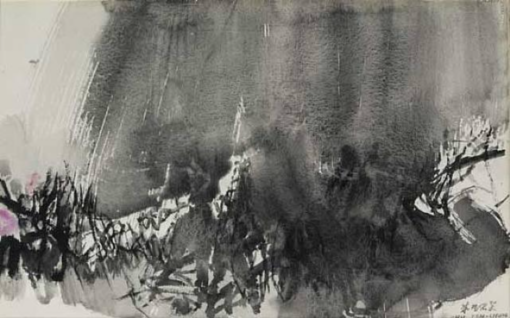
Tachisme was the French answer to abstract expressionism — the word comes from tache, a stain or a dab — and its discipline is the opposite of what it sounds like. It is not loose painting; it is painting in discrete touches, each one laid and left, with no blending between them and no correction afterwards. Chu Teh-Chun’s work of the early sixties sits inside that current, and Sans titre (1963) is a clean example of it: colour arriving in separate masses rather than in gradations, the surface carrying the record of each touch, and the composition held together by the rhythm of the marks rather than by any structure underneath them. What is his own, and what he brought from Hangzhou, is the calligraphic logic of those marks — they read as strokes made with a loaded brush and a whole arm, in the way Chinese ink painting reads, even when the result is entirely non-representational. Dated 1963, it belongs to the years when his palette was generally deeper and his masses more tightly packed than in the luminous canvases of his later career.
The Painting Itself
This is a hand-painted reproduction, painted by our studio artists in Dafen Village, Shenzhen, and the failure mode is blending. Everything in a tachiste painting depends on marks keeping their edges: paint is loaded onto the brush and laid in a single movement, wet against wet where the reference is wet against wet, and then left completely alone. Do not soften a transition to make it look atmospheric, do not drag a dry brush across a boundary to smooth it, do not airbrush, stipple or glaze over a passage to unify it. The dark grounds in this period are built in layers but must not end up looking like a printed gradient. Equally, do not go back into a stroke to fix its shape — the mark is the mark. Where the reference has thick paint, the paint is thick; where it is thin and translucent, it stays thin, and the two are never averaged into a middle thickness. Matte finish, no varnish, no added glazing medium. Each canvas is painted individually, so the placement and weight of the marks vary slightly piece to piece.
How to Place It
A living room, boardroom, gallery wall, hallway or hotel interior — a large-scale abstract that wants to be the largest thing on its wall. Hang it unframed on a deep stretcher or in a minimal float frame; anything decorative fights the surface. Deep grey, charcoal, plaster or warm white walls, and strong side light, which is what makes the raised paint visible. Do not hang it under glass, and do not hang it where a window reflects into it — glass and glare both destroy the only thing this picture has to offer, which is its surface.
Please Note
The original Sans titre is a work by Chu Teh-Chun (1920–2014), dated 1963 in the source record supplied to the studio. The medium of the original and its dimensions are not confirmed in that record and are to be verified before publication. The artist died in 2014 and the work remains protected by copyright; a commercial reproduction of it requires a licence, and none is held by the studio. This listing describes the composition reproduced in the reference image supplied to the studio. This product is a hand-painted reproduction made in our studio and is not affiliated with, endorsed by, or certified by the artist’s estate, the Fondation Chu Teh-Chun, ADAGP or any successor rights body, or any museum, gallery, auction house or rights holder. The artist’s name and title are used solely to identify the source work. This reproduction is supplied unsigned and unmarked, with no inscriptions on the front, the reverse or the stretcher. Colours may differ slightly from screen to screen and from the reference we work from.


| type | principal, Cadre 1 en alliage d'aluminium L : 0,5 cm, Cadre 2 L : 5 cm/2 pouces, Cadre 3 L : 9 cm/3,5 pouces, Cadre 4 L : 8 cm/2,4 pouces, Cadre 5 L : 8 cm/3 pouces, Cadre 6 L : 2 cm/0,8 pouce, Cadre 7 L : 5 cm/2 pouces, Cadre 8 en alliage d'aluminium L : 0,5 cm, Cadre 9 L : 0,5 cm, Cadre 10 L : 4 cm, Cadre 11 L : 6 cm, Cadre 12 L : 9 cm, Cadre 13 L : 1 cm, Cadre 14 bois L : 8 cm, N° 16 : bois L : 5 cm, N° 17 : bois L : 8 cm, N° 18 : bois L : 5 cm, N° 19 : bois L : 5 cm, N° 20 : bois L : 7 cm, N° 21 : bois L : 6,5 cm, N° 22 : bois L : 9 cm, N° 23 : bois L : 5 cm, N° 24 : bois L : 5 cm, N° 25 : bois L : 5 cm, N° 26 : bois L : 2,5 cm, N° 27 : bois L : 4 cm, N° 28 : bois L : 4 cm, N° 29 : bois L : 4 cm, N° 30 : bois L : 7,5 cm |
|---|



Avis
Il n’y a pas encore d’avis.