






Processus de peinture à la main
 Télécharger une photo – Art personnalisé (facultatif)

Téléchargez une photo et laissez nos artistes créer pour vous une peinture à l'huile personnalisée de qualité muséale. Choisissez la taille, le style d'encadrement et la finition artistique que vous préférez.
• Téléchargez une photo nette similaire à nos exemples pour obtenir un devis précis.
• Aperçu du cadre et visualisation de la pièce disponibles
• Vous avez plusieurs photos ? Laissez-nous un message et nos artistes vous aideront à faire votre choix.
• Si votre image se trouve sur un autre appareil, passez d'abord votre commande et envoyez-la par e-mail ultérieurement : [email protected]
220.00$
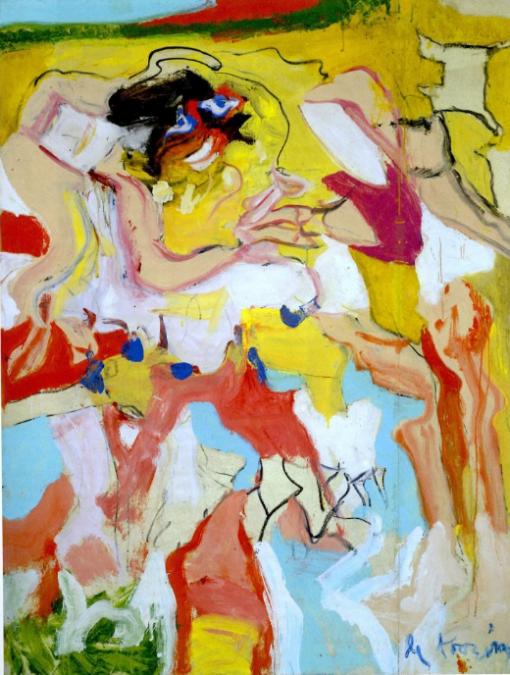
The Dancer (1972) dates from the moment de Kooning began working the other way round: from the early 1970s he traced forms from his own paintings onto large sheets of vellum, kept them as a catalogue of shapes, and let them feed back into new canvases — sometimes as the underdrawing of a painting still to come. A work like this one sits exactly at that hinge. The figure is drawn more than modelled: a body assembled out of contour lines, filled with paint that is scrubbed on thin and left open, so the paper and the drawing carry the weight rather than the pigment. A dancer is the right subject for it — the pose is held, off-balance, mid-movement, and the whole image keeps the provisional, provisional-but-decided quality of a drawing that has been allowed to become a painting.
The Painting Itself
This is a hand-painted reproduction, painted by our studio artists in Dafen Village, Shenzhen. The piece is a drawing at heart, so the sequence matters more than the paint: a lean oil base, kept thin and uneven, then the contour worked over it in drawn, broken lines that sometimes stop short of the form they describe. We resist filling the figure in. Where the original lets the ground come through — inside an arm, along a thigh, at the edge of the torso — the reproduction leaves it open too, because closing those gaps is what turns a drawn figure into a coloured one. Each canvas is painted individually, so the weight of the contour and the amount of bare ground vary slightly from piece to piece.
How to Place It
Vertical, figure-scale, and quiet in colour — this is the most forgiving of the large works to live with, and the one most likely to be hung in a room that is actually used. It wants a tall narrow wall: the end of a hallway, a pier between windows, the wall beside a bookcase, a study or dining room. Hang it so the figure stands at something close to human scale on the wall, centre around standing eye level, and keep at least half a metre clear on each side. Warm white, bone or pale plaster walls; a slim black, walnut or natural frame, or a float mount. Pair with wood, paper, linen, a single lamp — books nearby are fine here, unlike the Woman and Bicycle, which needs emptiness. Avoid bright accent colours; the piece is about line, and colour around it will pull attention away from the drawing.
Please Note
The original The Dancer (1972) is a work by Willem de Kooning (1904–1997), oil and charcoal on paper laid down on canvas, 175.3 × 133.4 cm. This product is a hand-painted reproduction made in our studio and is not affiliated with, endorsed by, or certified by the artist’s estate, The Willem de Kooning Foundation, ARS, or any gallery or private collection. The artist’s name and title are used solely to identify the source work. This reproduction carries no signature, monogram or mark of any kind. Colours may differ slightly from screen to screen and from the reference we work from.


| type | principal, Cadre 1 en alliage d'aluminium L : 0,5 cm, Cadre 2 L : 5 cm/2 pouces, Cadre 3 L : 9 cm/3,5 pouces, Cadre 4 L : 8 cm/2,4 pouces, Cadre 5 L : 8 cm/3 pouces, Cadre 6 L : 2 cm/0,8 pouce, Cadre 7 L : 5 cm/2 pouces, Cadre 8 en alliage d'aluminium L : 0,5 cm, Cadre 9 L : 0,5 cm, Cadre 10 L : 4 cm, Cadre 11 L : 6 cm, Cadre 12 L : 9 cm, Cadre 13 L : 1 cm, Cadre 14 bois L : 8 cm, N° 16 : bois L : 5 cm, N° 17 : bois L : 8 cm, N° 18 : bois L : 5 cm, N° 19 : bois L : 5 cm, N° 20 : bois L : 7 cm, N° 21 : bois L : 6,5 cm, N° 22 : bois L : 9 cm, N° 23 : bois L : 5 cm, N° 24 : bois L : 5 cm, N° 25 : bois L : 5 cm, N° 26 : bois L : 2,5 cm, N° 27 : bois L : 4 cm, N° 28 : bois L : 4 cm, N° 29 : bois L : 4 cm, N° 30 : bois L : 7,5 cm |
|---|





Avis
Il n’y a pas encore d’avis.