




Hand-Painted Process
 Upload Photo – Custom Art (Optional)

Upload a photo and let our artists create a museum-quality custom oil painting for you. Choose your preferred size, framing style, and artistic finish.
• Upload a clear photo similar to our samples for an accurate quote
• Frame preview and room visualization available
• Have multiple photos? Leave us a note and our artists will help you choose
• If your image is on another device, place your order first and email it later: [email protected]
220.00$
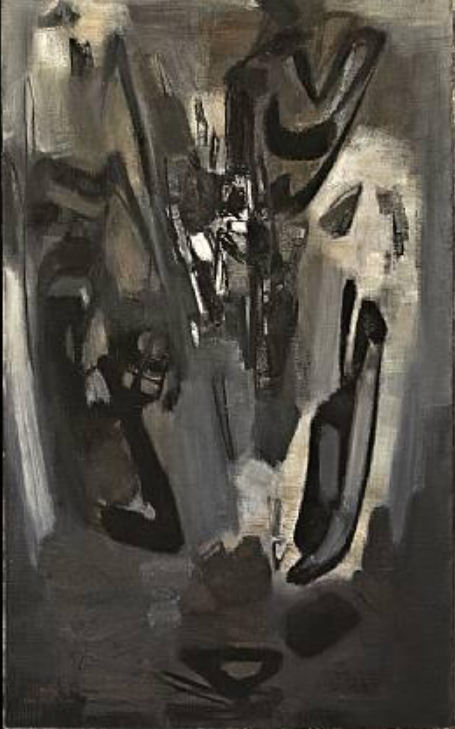
Chu Teh-Chun arrived in Paris in 1955, having trained in Hangzhou under Lin Fengmian alongside Zao Wou-Ki and Wu Guanzhong — a generation of Chinese painters sent to Europe with calligraphy in their hands. The decisive event came in 1956, when he saw a Nicolas de Staël retrospective and abandoned figuration on the spot. By 1959, the date of this Composition, he was four years into abstraction and painting in a register that owes as much to Chinese brushwork as to anything in Paris: broad, rhythmic strokes that behave like calligraphy rather than like gesture, laid over grounds built up in translucent layers so that light appears to come from inside the paint. In this period the palette tends darker and earthier than in his later, more luminous canvases, and the masses are denser and more central — characteristics worth knowing when you are judging a reproduction of an early work against the later ones. He went on to become the first Chinese-born painter elected to the Académie des Beaux-Arts in Paris, but in 1959 none of that had happened yet; this is a painting by a man still working out what abstraction could be.
The Painting Itself
This is a hand-painted reproduction, painted by our studio artists in Dafen Village, Shenzhen, and it is the most demanding canvas in the catalogue. Two things have to be right or the picture fails. First, the layering: the ground is built from thin, translucent coats, each dry before the next, so that the colour has depth and light rather than a flat surface; where the reference is dense and opaque, the paint is laid thick and left alone. Second, the strokes: a calligraphic mark has to be made once, at speed, with the whole arm, and never retouched. Going back over a stroke to fix its edge turns a gesture into a shape, and a Chu Teh-Chun made of shapes looks like a poster. The failure mode to watch for is a flat, evenly painted imitation with clean edges — that is exactly what this painting is not. Matte finish, no varnish, no glazing medium added to flatten the surface. Each canvas is painted individually, so the density of the impasto and the exact balance of the layers vary piece to piece.
How to Place It
A living room, hallway, boardroom, hotel lobby or any wall where a large abstract can hold the space on its own. This is the first picture in the catalogue that is comfortable at real scale — abstractions want size, and a small canvas of this kind of work reads weakly. Frame minimally, or hang it unframed on a deep stretcher; a heavy frame fights the gesture. Warm white, plaster, charcoal or deep grey walls, and light from one side so the impasto casts its own small shadows. Do not hang it opposite a window, where glare will flatten exactly the surface the painting is about.
Please Note
The original Composition is a work by Chu Teh-Chun (1920–2014), dated 1959 in the source record supplied to the studio. The medium of the original and its dimensions are not confirmed in that record and are to be verified before publication. The artist died in 2014 and the work remains protected by copyright; a commercial reproduction of it requires a licence, and none is held by the studio. This listing describes the composition reproduced in the reference image supplied to the studio. This product is a hand-painted reproduction made in our studio and is not affiliated with, endorsed by, or certified by the artist’s estate, the Fondation Chu Teh-Chun, ADAGP or any successor rights body, or any museum, gallery, auction house or rights holder. The artist’s name and title are used solely to identify the source work. This reproduction is supplied unsigned and unmarked, with no inscriptions on the front, the reverse or the stretcher. Colours may differ slightly from screen to screen and from the reference we work from.


| type | main, Frame1 Al alloy W:0.5cm, Frame2 W:5cm/2in, Frame3 W:9cm/3.5in, Frame4 W:8cm/2.4in, Frame5 W:8cm/3in, Frame6 W:2cm/0.8in, Frame7 W:5cm/2in, Frame8 Al alloy W:0.5cm, Frame9 W:0.5cm, Frame10 W:4cm, Frame11 W:6cm, Frame12 W:9cm, Frame13 W:1cm, Frame14 wood W:8cm, No.16:wood w:5cm, No.17:wood w:8cm, No.18:wood w:5cm, No.19:wood w:5cm, No.20:wood w:7cm, No.21:wood w:6.5cm, No.22:wood w:9cm, No.23:wood w:5cm, No.24:wood w:5cm, No.25:wood w:5cm, No.26:wood w:2.5cm, No.27:wood w:4cm, No.28:wood w:4cm, No.29:wood w:4cm, No.30:wood w:7.5cm |
|---|



Reviews
There are no reviews yet.