




Proceso de pintura a mano
 Subir foto – Arte personalizado (opcional)

Sube una foto y deja que nuestros artistas creen para ti un cuadro al óleo personalizado con calidad de museo. Elige el tamaño, el estilo de marco y el acabado artístico que prefieras.
• Sube una foto nítida similar a nuestras muestras para obtener un presupuesto preciso.
• Vista previa del marco y visualización de la habitación disponibles.
• ¿Tienes varias fotos? Déjanos una nota y nuestros artistas te ayudarán a elegir.
• Si tu imagen está en otro dispositivo, haz primero tu pedido y envíala por correo electrónico más tarde: [email protected]
180.00$
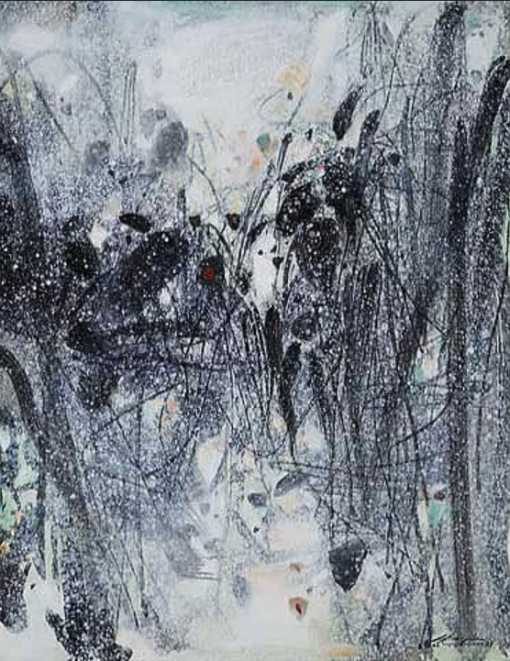
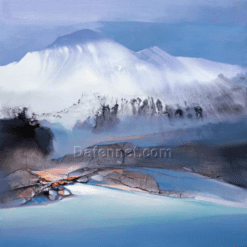
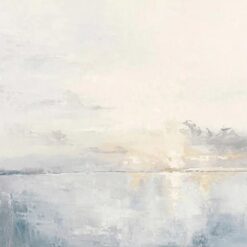
Dominant Bleu y Evocation Bleue, made a year apart, are two different ideas about the same colour, and the titles say it. One is about dominance — blue taking over the field; this one is about evocation — blue summoning something that is not pictured. The difference is in how the paint behaves: in the tachiste manner, colour arrives in discrete touches that keep their edges, and the atmosphere is produced by layering those touches over translucent ground rather than by blending one colour into another. By 1989 Chu Teh-Chun had been painting for more than three decades in Paris and had long since arrived at this register — the dense masses of the sixties gone, the light of the eighties in place — and the blue canvases of this moment are among the works that most clearly show the Chinese half of his formation. The marks read as brushstrokes made with a loaded brush in a single movement, in the logic of ink rather than of European gesture, even though nothing in the picture is representational. Where the earlier works ask the viewer to read structure, this one asks them to read atmosphere.
The Painting Itself
This is a hand-painted reproduction, painted by our studio artists in Dafen Village, Shenzhen. The tachiste discipline applies and the blue makes it stricter. Each mark is loaded, laid in one movement and left — no blending, no stippling, no airbrushing, no dragging a dry brush across a boundary to make it misty. The atmosphere in this painting is built by layering translucent coats and letting the loaded touches sit on top of them; it is never produced by smearing one passage into another, and a reproduction that looks foggy or airbrushed has failed even if it is tonally accurate. On the field: thin coats across the whole canvas in one continuous session so the density stays even, no white lifted in at the end, no black dropped in to deepen. On the clarity of the edge: where the reference has a hard boundary between two blues, that boundary is drawn by the paint stopping, not by a transition. Match the blues against a physical swatch under daylight and check for drift toward purple. Matte finish, no added medium, no varnish. Each canvas is painted individually, so the exact blues and the placement of the marks vary piece to piece.
How to Place It
A living room, hallway, lobby, bedroom or boardroom — atmospheric blue abstracts are the most widely placeable pictures in the catalogue, and this one is softer and more suggestive than Dominant Bleu, so it suits quieter rooms rather than statement walls. Large scale, unframed on a deep stretcher or a thin float frame, side-lit, not behind glass. Warm white, plaster, sand, pale grey or charcoal walls. If you hang both blue canvases in one interior, separate them by a room rather than putting them side by side — as a pair they read as two versions of one idea, which is exactly what the titles say they are not.
Please Note
The original Evocation Bleue is a work by Chu Teh-Chun (1920–2014), dated 1989 in the source record supplied to the studio. The medium of the original and its dimensions are not confirmed in that record and are to be verified before publication. The artist died in 2014 and the work remains protected by copyright; a commercial reproduction of it requires a licence, and none is held by the studio. This listing describes the composition reproduced in the reference image supplied to the studio. This product is a hand-painted reproduction made in our studio and is not affiliated with, endorsed by, or certified by the artist’s estate, the Fondation Chu Teh-Chun, ADAGP or any successor rights body, or any museum, gallery, auction house or rights holder. The artist’s name and title are used solely to identify the source work. This reproduction is supplied unsigned and unmarked, with no inscriptions on the front, the reverse or the stretcher. Colours may differ slightly from screen to screen and from the reference we work from.


| tipo | Principal, Marco 1 Aleación de aluminio Ancho: 0,5 cm, Marco 2 Ancho: 5 cm/2 pulgadas, Marco 3 Ancho: 9 cm/3,5 pulgadas, Marco 4 Ancho: 8 cm/2,4 pulgadas, Marco 5 Ancho: 8 cm/3 pulgadas, Marco 6 W: 2 cm/0,8 pulgadas, Marco 7 W: 5 cm/2 pulgadas, Marco 8 Aleación de aluminio W: 0,5 cm, Marco 9 W: 0,5 cm, Marco 10 W: 4 cm, Marco 11 W: 6 cm, Marco 12 W: 9 cm, Marco 13: 1 cm, Marco 14: madera: 8 cm, N.º 16: madera: 5 cm, N.º 17: madera: 8 cm, N.º 18: madera: 5 cm, N.º 19: madera: 5 cm, N.º 20: madera: 7 cm, N.º 21: madera: 6,5 cm, N.º 22: madera: 9 cm, N.º 23: madera, 5 cm, N.º 24: madera, 5 cm, N.º 25: madera, 5 cm, N.º 26: madera, 2,5 cm, N.º 27: madera, 4 cm, N.º 28: madera, 4 cm, N.º 29: madera, 4 cm, N.º 30: madera, 7,5 cm. |
|---|



Valoraciones
No hay valoraciones aún.