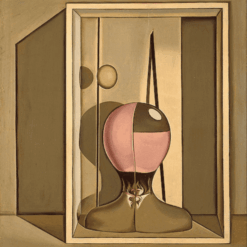

Morandi (1890–1964) rarely left Bologna. He lived and worked at Via Fondazza with his sisters, taught drawing at the city’s art academy, and made his subjects out of what stood on a table in front of him — a bottle, a vase, a box, a paper flower — rearranged, repainted, redrawn until the arrangement stopped being objects and became a tone.
Three groups carry the category:
– The still lifes, and the great late ones especially: forms so unified with the ground that the bottle is less a shape than a place where the grey turns slightly warmer.
– The landscapes of the Bologna outskirts and Grizzana — low hills, walls, a few trees, reduced to bands of ochre and slate, painted with the same restraint as the bottles.
– The rare flower pieces, looser, almost weightless, all white and dust rose.
What to look for: a contour drawn with a fine brush and then half-erased, so the edge sits in the air rather than on the object; a surface that absorbs light instead of reflecting it; shadows that are not dark but simply a different warm grey. Morandi’s light is diffuse — nothing casts a hard shade.