





Dafen Ölgemälde Dorf
Das Dorf Dafen in der Krise: Der Verlust von Talenten in der Ölmalerei
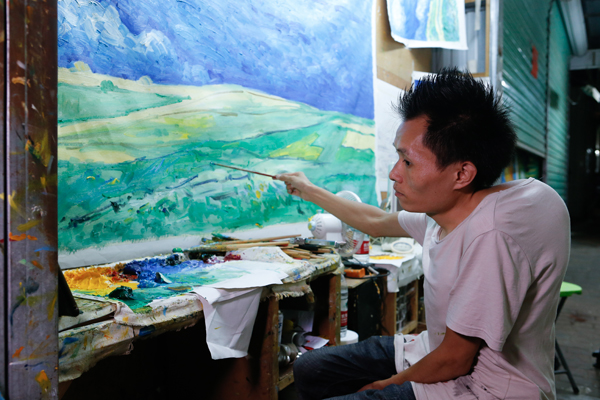

A village can be famous for what it makes and still fail to make a home.
In Shenzhen, where land is measured in pressure and time is always priced at tomorrow, Dafen Dorf once felt like a bright, crowded canvas—layer after layer of hands at work, paint in the air, commerce humming beneath the surface sheen. For years it was called China’s No. 1 oil painting village, a place that could turn pigment into livelihood at an industrial pace. Yet the very efficiency that kept the village alive also thinned its oxygen. What grows fast can grow shallow. What repeats can become brittle.
Now a rumor travels through the city’s art circles like a draft through an open door: Dafen is moving. Not by trucks and cranes, not by an official decree—by people. By painters folding their lives into cardboard, by studios emptying out one easel at a time, by talent pulled toward a new site in southern Jiangxi. In August, in Shangyou County, a fresh complex rose with an ambitious name—an oil painting industrial hub—and with it, a gravitational field strong enough to bend trajectories that once seemed fixed.
It is tempting to read this as collapse, to say the old village is fading. But the more honest image might be simpler: the light is shifting, and those who depend on light are turning their faces to follow it.
1) Dafen’s Thin Walls: Work Without Belonging
Dafen has never lacked activity. It has lacked settling.
To live as an artist, you need more than a room to work in. You need a sense that the room will still be yours next season, that the street outside is not only a corridor for transactions, that the community has a spine. But in Dafen, rent rises like tidewater and the price of a painting—especially a painting made for speed—rarely rises in step. Young painters arrive with new degrees and old hopes, then learn quickly what hope costs when it is purchased daily.
They speak, often, of imbalance: materials paid upfront, marketing paid upfront, rent paid upfront—while income arrives late, if it arrives at all. Months can pass without a “big order.” A studio can be full of canvases and still feel empty. In that kind of weather, “going home” becomes a recurring phrase—spoken like a prayer, or a bruise pressed and tested. But home, for many, offers no market, no infrastructure, no place for their skill to land. So they remain suspended between cities: unable to thrive where they are, unable to return to where they came from.
This is not the first time Dafen’s painters have drifted away. There have been earlier waves—moments when the market cooled and the village offered no clear transformation beyond endurance. When the demand for volume softened, the ecosystem built for volume had little to feed its inhabitants. The village, some critics argue, trained painters to supply the market more than to develop a voice. When the market turned, the village turned with it—yet did not change its bones.
Beijing and Shanghai absorbed some of the leaving, but at a cost. High living expenses, long commutes, crowded ambitions. The dream endured, though it often did so in cramped apartments and borrowed time. And then, unexpectedly, another option appeared: closer to many artists’ native provinces, broader in land, greener in view—a place claiming it could offer something Dafen rarely did.
Belonging.
2) Shangyou’s Offer: Capital, Landscape, and a Designed Utopia
From August onward, some painters who once worked in Dafen began to build a different routine in southern Jiangxi. The pitch is straightforward: nature, affordability, infrastructure, and a system that promises stability.
The new site is described with the language of arrival: the airport is nearby; the drive is short; the scenery is generous. Mountains and water are not decoration here but argument—evidence that the mind can loosen, that the eye can refill, that a painter can find subject matter without forcing it. Inside the buildings, the practical comforts matter too: studios arranged, equipment provided, spaces for rest, exercise, gathering. Even the small gesture of an “opinion box” suggests an institution trying to listen, trying to make artists feel counted.
The larger ambition is economic and administrative. Local projections speak of billions in investment, thousands of creators, and a complete chain—training, logistics, exhibitions, trade, housing—designed as one integrated engine. The new hub does not pretend to be an accident of history. It is planned, funded, and promoted with the confidence of a blueprint.
To Dafen, it feels like a pry bar slipped under a loose plank. The numbers being discussed—hundreds of painters already moved, more possibly following—create a narrative of “poaching.” The hub’s founder speaks like someone who believes a perfect storm can be engineered: a place where production, sales, and even authentication are built into the same architecture; where artists are supported not only by inspiration but by systems. He uses a word artists have always treated carefully—utopia—and proposes that administrative force and capital might build what organic communities take decades to grow.
Whether such a place can truly breathe is another question. But it is undeniable that the offer has edges that cut directly into Dafen’s soft spots.
3) Movement Is Not Proof of Decline—But Dafen Still Must Change
Some observers refuse the obituary. Artists move; artists gather and disperse; the geography of art is never permanent. What looks like migration can be simply the ordinary restlessness of creative labor—an ecosystem responding to cost, opportunity, and mood.
There is also skepticism toward the idea of “enclosing” artists, of managing creativity like inventory. You can build studios and parks, you can concentrate resources, but you cannot guarantee a living scene the way you guarantee a road or a bridge. True creative work has a stubborn independence. It can happen anywhere, and often does—far from the places that call themselves centers.
Yet Dafen carries an older stain that is hard to wash out: its deep association with copying, with replication, with speed over originality. Even if the village survives economically, it risks surviving only as a shorthand—an emblem of manufacturing rather than creating. That reputation is not merely external; it shapes the internal logic of the village, the incentives, the way young painters are trained to think about a canvas.
So the question is not only whether Dafen is “falling.” It is whether Dafen can become something else—something that does not rely on endless repetition for oxygen.
Because an art community cannot live on commerce alone. Commerce can keep the lights on, but it cannot always keep the light moving. For that, artists need more: time, space, dignity, and a feeling that their lives are not temporary scaffolding around someone else’s transaction.
If Shangyou is offering a designed environment—landscape, support, a sense of institutional belonging—Dafen must answer with its own redesign. Not only in infrastructure, but in purpose. Not only in branding, but in how it treats the people whose labor made its name.
A village that once painted the world for the world now faces a more intimate task: to repaint itself, not as a factory of images, but as a place where an artist can stand, breathe, and stay.
And if it cannot—then the leaving will continue, quietly, like the slow removal of color from a canvas left too long in harsh sun.
